

If you’re wondering about the plural of index, you’ve probably come across two forms: indexes and indices. Both are correct, but they aren’t always used in exactly the same contexts. The choice often depends on what index means in a particular sentence and whether you’re writing about books, data, mathematics, finance, or another specialized field.
The good news is that you don’t need to memorize a complicated rule. Once you understand how indexes and indices developed and where each form is commonly used, choosing the right plural becomes much easier.
Must read about: By Hook or by Crook: What It Means and How to Use It
Indexes or Indices: Which Plural Is Correct?
Both indexes and indices are accepted plural forms of index.
The regular English plural is indexes, formed by adding -es to the singular noun. The alternative indices comes from the Latin plural of index and remains especially common in mathematics, science, and other technical contexts.
For example:
- “The librarian created several indexes for the collection.”
- “The mathematical formula contains several indices.”
- “Several stock market indexes gained value.”
- “The tensor contains multiple indices.”
Notice that the choice can change with the subject. A book publisher might commonly talk about indexes, while a mathematician may naturally refer to indices.
This distinction is not an absolute rule, however. In some fields, both forms appear.
What Does “Index” Mean?
An index is generally a system or reference point used to organize, locate, measure, or represent information.
The meaning changes according to context.
In a book, an index is an alphabetical list of subjects, names, or concepts that helps readers locate information quickly. In mathematics, an index can be a number or symbol that identifies a particular element in a sequence or expression. In economics and finance, an index can represent the performance or movement of a group of assets, prices, or other measurements.
The word can therefore function as both an ordinary noun and a specialized technical term.
For example:
“Check the index at the back of the book.”
Here, index means a reference list.
In another context:
“The price index increased this year.”
Here, index refers to a statistical measurement.
And in mathematics:
“The index identifies the position of the element.”
The underlying idea is related: an index helps identify, organize, measure, or point to something.
You will must like reading about: Metonymy vs Synecdoche: What’s the Difference?
Where Does the Word “Index” Come From?
The noun index comes from Latin, where index refers to an indicator, pointer, sign, or one who points something out. English adopted the word and gradually developed several related meanings.
Its Latin origin helps explain why English has retained the traditional plural indices.
However, English often changes borrowed words so they fit ordinary English grammar. That process gave rise to indexes, which follows the familiar English plural pattern.
This is why both forms have survived.
The history of the word is interesting, but you don’t need to know Latin grammar to use either plural correctly. Modern English speakers treat index as an established English noun.
When Should You Use “Indexes”?
Indexes is the straightforward English plural and works well in general writing.
It is particularly natural when index refers to books, databases, websites, catalogs, collections, or general reference systems.
For example:
- “The publisher included detailed indexes at the end of the books.”
- “Search engines create indexes of web pages.”
- “The library uses several indexes to organize its records.”
- “The database contains multiple indexes for faster searches.”
The form indexes can also be used in finance and economics, where many publications use it to describe multiple market indicators.
For example:
“Several major stock market indexes ended the day higher.”
This usage is common and completely acceptable.
Why Is “Indexes” Easy to Use?
The answer is simple: it follows a familiar English pattern.
English regularly forms plurals by adding -s or -es. Since index ends in the letter x, the plural is normally written with -es:
index → indexes
You can see a similar pattern in words such as:
- box → boxes
- tax → taxes
- fox → foxes
- prefix → prefixes
This makes indexes an intuitive choice for general English writing.
When Should You Use “Indices”?
Indices is the traditional Latin-derived plural and is especially common in technical or academic language.
You’re likely to encounter it in mathematics, statistics, science, economics, and other specialized fields.
For example:
“The equation contains three indices.”
Or:
“The researcher compared several economic indices.”
In mathematics, indices are particularly familiar because an index can refer to a position, subscript, or identifying value associated with a mathematical object.
For example:
“The indices indicate the position of each element in the matrix.”
In such contexts, indices may sound more natural to specialists.
However, this does not mean that indices are automatically more sophisticated or more correct. Its suitability depends on context.
Must read about: What Is the Plural of “Cactus”? Cactuses or Cacti?
Is “Indices” More Correct Than “Indexes”?
No.
A common misconception is that indices is the only correct plural because index comes from Latin. Modern English doesn’t work that way.
English has adopted countless words from other languages and often gives them regular English plurals. Once a borrowed noun becomes established, English speakers may preserve the original plural, develop an English plural, or use both.
With index, both forms have become established:
index → indexes
index → indices
Therefore, saying that indexes are wrong would be inaccurate.
Indexes vs. Indices in Different Contexts
Context is the easiest way to understand the difference.
| Context | Common plural |
| Book reference lists | Indexes |
| Library catalogs | Indexes |
| Databases | Indexes |
| Websites and search systems | Indexes |
| Stock markets | Indexes |
| Mathematics | Indices |
| Scientific formulas | Indices |
| Statistics | Indices |
| Technical writing | Indices or indexes, depending on the field |
These are tendencies rather than rigid grammar rules.
For instance, a financial writer may use indices, especially in British English or formal financial writing. Another writer may use indexes for the same type of market indicators.
The audience and style of the publication can influence the choice.
The Plural of Index in Mathematics
Mathematics provides one of the clearest examples of where indices are commonly used.
An index can identify an element, position, variable, or component in a mathematical expression. When several such identifiers are involved, mathematicians often refer to them as indices.
For example:
“The indices identify the rows and columns of the matrix.”
Here, indices are the conventional technical choice.
You may also encounter the word in discussions of exponents. In some varieties of English, indices can refer to powers or exponents.
For example:
“The indices of the variables determine how the expression changes.”
The exact terminology can vary by mathematical tradition, but indices are well established in mathematical language.
What Is an Index in Mathematics?
In mathematics, an index often acts as a label that identifies an item in a sequence, array, matrix, or other structured collection.
Consider a simple sequence:
a₁, a₂, a₃, a₄
The numbers 1, 2, 3, and 4 can serve as indices, identifying the positions of the elements.
In more advanced mathematics, indices can carry considerably more information. They may identify dimensions, coordinates, components, or positions in mathematical objects.
This specialized meaning is one reason indices remain particularly common in mathematical writing.
The Plural of Index in Books

When index means the alphabetical reference section at the back of a book, indexes is very common.
For example:
“The textbook contains separate indexes for names and subjects.”
Here, indexes clearly refer to reference lists.
A book can have:
- an author index,
- a subject index,
- a keyword index,
- a geographic index,
- or several specialized indexes.
In publishing, therefore, indexes are a natural and widely accepted choice. That said, you may still encounter indices in academic or specialized publishing. The important thing is not to assume that one form is grammatically forbidden.
The Plural of Index in Finance
The financial world provides another interesting example.
A stock market index measures the performance of a selected group of securities. Examples include major market benchmarks that track companies, sectors, or broader economic activity.
When referring to several such measurements, both indexes and indices can appear.
For example:
“Major stock market indexes rose during the session.”
Or:
“Several global market indices declined.”
Both sentences are understandable and grammatically acceptable.
Your choice may depend on the publication’s style guide, regional variety of English, or professional convention.
Indexes or Indices in British and American English
Usage can also vary between varieties of English.
Indexes is widely accepted in both American and British English, particularly when the word has a general meaning.
Indices are also used in both varieties, especially in mathematical, scientific, and technical contexts.
Therefore, it would be misleading to say that indexes belong exclusively to American English or that indices belong exclusively to British English.
The field and meaning often matter more than geography.
Is “Indexes” a Regular English Plural?
Yes.
Indexes is formed according to ordinary English pluralization:
index + es = indexes
This is a good example of how English adapts words borrowed from other languages.
Instead of preserving the original Latin plural in every situation, English speakers have developed a regular plural that fits the language’s existing grammar.
The same process can be seen in many other borrowed nouns. Some retain older plural forms, while others develop regular English alternatives.
This flexibility is one of the reasons English contains so many competing plural patterns.
Is “Indices” a Latin Plural?
Yes. Indices come from the traditional Latin plural associated with index.
In Latin, index belonged to a noun pattern in which the plural could end in -es. English retained this form in technical and scholarly usage.
Over time, however, English speakers also created the regular plural indexes.
So the two forms have different grammatical histories:
- Indexes → regular English plural
- Indices → traditional Latin-derived plural
Both are now part of modern English vocabulary.
Why Does English Keep Both Forms?
English is full of words that preserve traces of their linguistic history.
When a word enters English from another language, speakers don’t always replace its original grammar immediately. Sometimes the traditional form remains popular in specialized fields while a regular English form develops alongside it.
That appears to be what happened with the index.
In everyday writing, indexes can feel natural because it follows a familiar English pattern. In technical fields, indices may remain preferred because specialists inherited the traditional terminology.
Neither form needs to disappear for the other to be correct.
Common Mistakes With the Plural of Index
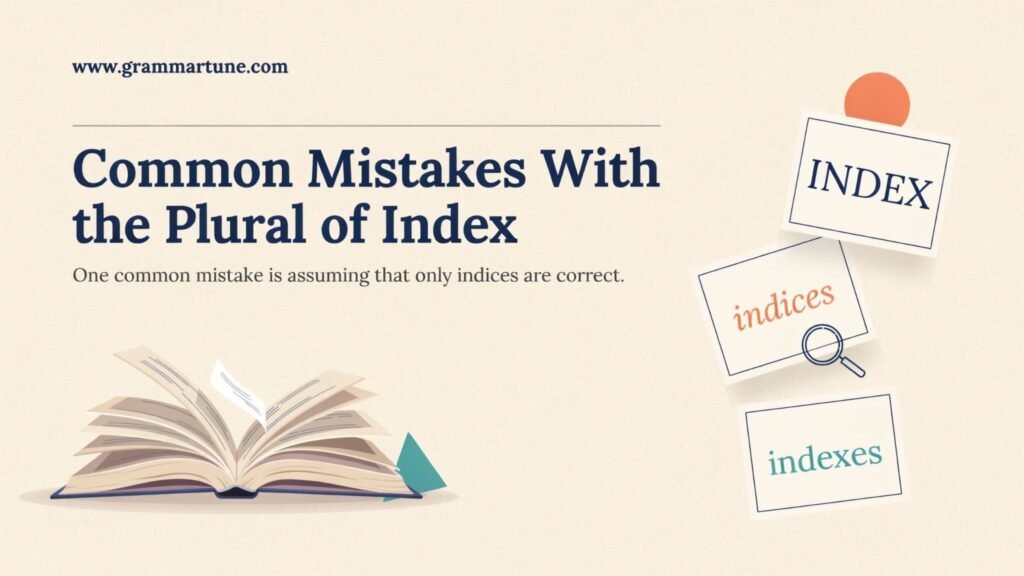
One common mistake is assuming that only indices are correct.
That belief usually comes from the idea that a Latin-origin word must keep its Latin plural. English does not require this.
Another mistake is treating indices as singular.
For example:
“The indices are shown below.”
This is incorrect when indices refer to multiple items.
Use:
“The indices are shown below.”
The singular is index:
“The index is shown below.”
The plural is indexes or indices:
“The indexes are shown below.”
“The indices are shown below.”
What About “Index’s”?
Index’s is not a plural. It is normally the possessive form of the singular noun.
For example:
“The index’s final section contains several references.”
Here, the apostrophe indicates possession.
For multiple indexes, the possessive would normally be:
“The indexes’ entries are alphabetized.”
The apostrophe position changes because the noun is plural.
This distinction is useful because punctuation can sometimes make plural and possessive forms look confusing.
Examples of Index, Indexes, and Indices
The easiest way to remember the difference is to see the forms in real sentences.
Singular: Index
“The index at the back of the book lists important topics.”
Regular plural: Indexes
“The books contain detailed indexes.”
Traditional plural: Indices
“The mathematical expression contains several indices.”
General technical use
“Researchers compared several statistical indices.”
Database context
“The system uses multiple indexes to retrieve records quickly.”
Financial context
“Several major market indexes finished higher.”
Mathematical context
“The indices identify the elements in the sequence.”
These examples show why context matters more than a simple rule such as “always use indices.”
How to Choose Between Indexes and Indices
If you’re unsure which form to use, ask yourself what index means in your sentence.
If you are talking about books, databases, websites, catalogs, or general reference systems, indexes are often a natural choice.
If you are discussing mathematics, formulas, statistics, or specialized scientific terminology, indices may be the more conventional choice.
If you are writing about finance or economics, either form may be appropriate depending on the style of your publication.
Most importantly, check the terminology normally used by your field or organization when consistency matters.
A Simple Memory Trick
Think of the two forms this way:
Indexes = everyday English
Indices = traditional/technical usage
This isn’t an absolute rule, but it provides a useful starting point.
If you’re writing a general sentence and don’t have a specialized reason to choose indices, indexes is a perfectly safe plural.
If you’re writing mathematics or another technical subject where indices is standard terminology, use indices.
Frequently Asked Questions
What is the plural of index?
The plural of index can be indexes or indices. Both are correct, although their usage varies by context.
Are indexes grammatically correct?
Yes. Indexes is the regular English plural of index and is especially common in general writing, publishing, databases, and many financial contexts.
Is indices grammatically correct?
Yes. Indices is the traditional Latin-derived plural and is particularly common in mathematics, science, statistics, and technical writing.
Which is better: indexes or indices?
Neither is universally better. Choose the form that fits your context and the terminology used by your field. Indexes is often suitable for general English, while indices is common in technical contexts.
What is the singular of indices?
The singular form of indices is index.
For example:
- One index
- Two indices
- Several indices
Can I use indexes in mathematics?
Yes, but indices are often the more traditional or conventional choice in mathematical writing. If a textbook, institution, or style guide uses indices, it is best to follow that convention.
Can I use indices for book indexes?
Yes. Indices can be used, although indexes are very common when referring to alphabetical reference sections in books.
Is indices only used in British English?
No. Indices is used in both British and American English, especially in technical and academic contexts.
Is “indexes” a mistake?
No. Indexes is a correct plural form of index. It should not be treated as an error simply because indices have a Latin origin.
You will be must like reading about: Simile vs Metaphor: Definitions, Differences, and Usage
Final Takeaway
So, what is the plural of index? The answer is both indexes and indices.
Indexes is the regular English plural and works naturally in many general contexts, including books, databases, websites, and financial writing. Indices is the traditional Latin-derived plural and is especially common in mathematics, statistics, science, and other technical fields.
The simplest way to remember the distinction is:
- Index = singular
- Indexes = regular English plural
- Indices = traditional Latin-derived plural
Neither form is automatically more correct than the other. Instead, let the meaning, context, audience, and conventions of your field guide your choice.
If you’re writing a general sentence, indexes are usually an easy and natural option. If you’re discussing mathematical or scientific concepts, indices may fit the terminology better. Once you understand this difference, you can use both forms confidently without worrying that one is inherently wrong.

Joulia, a seasoned wordsmith and grammar enthusiast, brings over a decade of blogging expertise to Grammar Tune. With a keen eye for linguistic precision and a passion for making complex grammar concepts accessible, he has helped thousands of readers enhance their writing skills. His engaging teaching style and practical approach to language learning have made him a trusted voice in the online grammar community.